Re&Up Recycling Technologies has secured B Corp certification with an exceptional score of 96.4 on the B Lab assessment. The specialized textile recycling venture, owned by the Sanko Group, nearly doubles the median score of 50.9 recorded by ordinary businesses. This achievement places Re&Up among a select group of companies that balance financial growth with verified social and environmental responsibility.
The certification validates Re&Up's adherence to rigorous standards across governance, workers, community, environment, and customer stewardship. For B2B textile buyers and brands seeking sustainable supply chain partners, this milestone signals a new benchmark of accountability in textile-to-textile recycling. Stay current on industry developments through the textile news section on textilezon.com.
A Record-Breaking B Corp Assessment Score
To earn B Corp status, a business must score at least 80 points on the B Lab assessment — a globally recognized benchmark for social and environmental performance. Re&Up achieved 96.4 points, awarded under the previous B Lab model. The company's result is nearly double the 50.9 median score for ordinary businesses.
This evaluation covered five key pillars: governance, workers, community, environment, and customer stewardship. The wide margin above the 80-point threshold reflects the depth of Re&Up's operational transparency and sustainability commitments. It sets a clear standard for what certified circularity looks like in industrial textile recycling.
Thermochemical Innovation Behind Sustainable Fibers
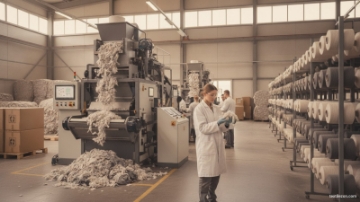
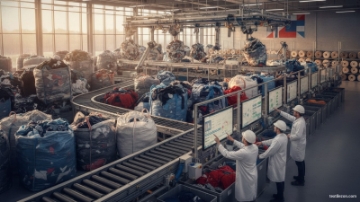
Re&Up employs a proprietary thermochemical recycling process to convert textile waste into high-purity, next-generation materials. The company produces two primary outputs for the circular textile supply chain:
- Next-gen cotton — recycled cotton fiber designed for circular textile production
- Polyester chips — recycled polyester feedstock for fiber and fabric manufacturing
These sustainable fibers already reach major global brands, including Puma and Only. Re&Up currently delivers 80,000 metric tons of sustainable fibers annually. The company's newly launched Fiber Club initiative is designed to expand this supply partnership to additional brand partners.
Scaling Toward 1 Million Metric Tons by 2030
Headquartered in the Netherlands, Re&Up operates two industrial-scale recycling facilities in Turkey. The company has set an ambitious target of 1 million metric tons of textile recycling capacity by 2030 — a scale that would place it among the largest textile recyclers globally.
Ebru Özküçük Güler, Chief Sustainability Officer at Re&Up, stated that the B Corp certification reflects a long-term vision where innovation and circularity operate in unison. She noted it recognizes the transformation of textile waste into high-purity resources with genuine accountability. The result reinforces Re&Up's commitment to measurable, transparent operational responsibility across its full value chain.
As global brands face growing scrutiny over environmental claims, Re&Up's technology-driven and certified approach to textile waste management offers the industry a replicable, verified model. The 96.4 B Corp score positions Re&Up as a leading benchmark for sustainable performance in circular textile manufacturing.
Frequently Asked Questions
What is B Corp certification and why does it matter in the textile industry?
B Corp certification is granted by B Lab to companies meeting verified standards for social and environmental performance, accountability, and transparency. In the textile sector, it provides third-party validation of sustainability claims — a critical credential for B2B supply chain partnerships and global brand collaborations.
What score did Re&Up achieve on the B Lab assessment?
Re&Up Recycling Technologies scored 96.4 points on the B Lab assessment, awarded under the previous B Lab model. The minimum threshold for B Corp certification is 80 points, while the median score for ordinary businesses stands at 50.9 points.
What sustainable fiber products does Re&Up produce and supply?
Re&Up produces next-gen cotton and polyester chips through its thermochemical recycling process. The company supplies 80,000 metric tons of sustainable fibers annually to brands including Puma and Only, with a capacity expansion target of 1 million metric tons by 2030.