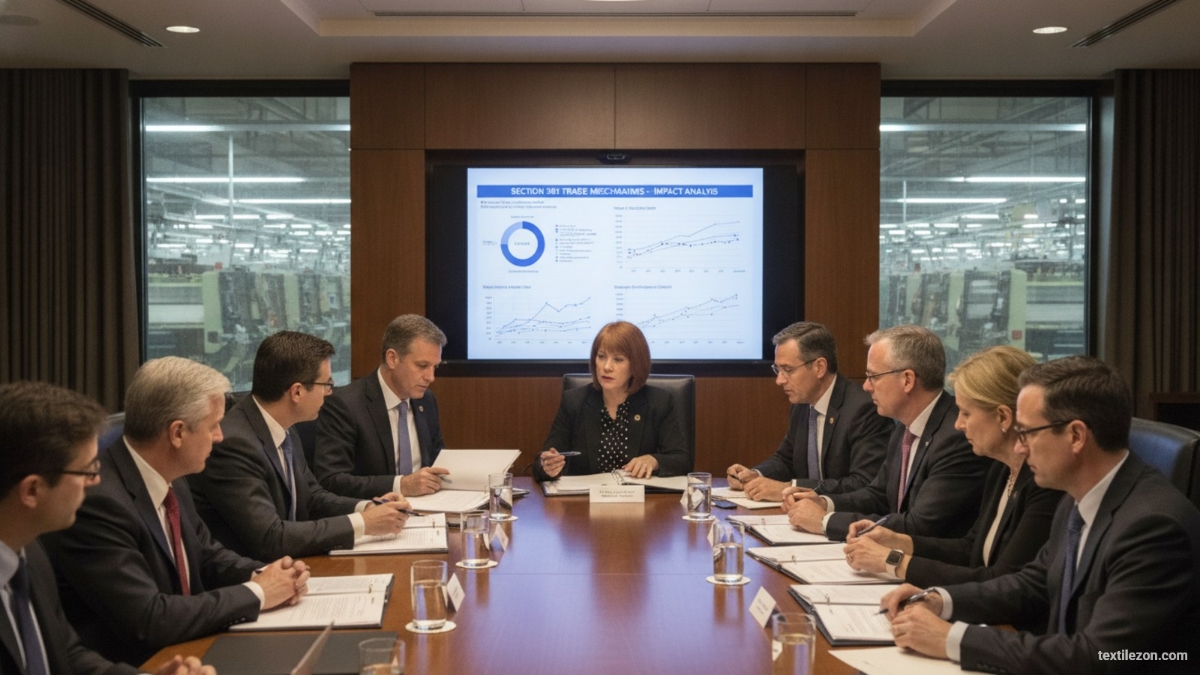
The National Council of Textile Organizations (NCTO) issued a formal statement on July 24, 2026. It opposes a key element of the U.S. administration's latest Section 301 forced labor tariff package. NCTO warns the proposed textile mechanism could harm the very domestic manufacturers it is designed to protect. The group represents the full U.S. textile supply chain, from fiber and yarn to finished sewn products.
Section 301 Action and the Textile Mechanism Explained
The administration announced it will impose Section 301 tariffs on goods from 60 economies that have failed to enforce prohibitions on forced labor imports. The policy directly targets supply chains linked to Uyghur forced labor in China's Xinjiang region.
Under a specific textile mechanism, imports from Bangladesh, Cambodia, Indonesia, and Malaysia will receive relief from Section 301 duties. That relief is tied to those economies' purchases of U.S. cotton and textiles through tariff-rate quotas (TRQs).
Goods entering the U.S. duty-free under USMCA or CAFTA-DR are excluded from the Section 301 tariffs — a provision NCTO has welcomed. However, the administration did not exempt textile inputs and machinery unavailable domestically, blocking critical supply chain reshoring efforts.
NCTO's Concerns Over Offshoring Incentives
NCTO President and CEO Kim Glas stated that no industry has suffered more from forced labor than U.S. textiles. The sector employs 453,000 workers and has lost 41 plants over the past two-plus years.
Glas argues that including raw cotton in the mechanism creates a direct offshoring incentive. It lowers the cost of Asian apparel imports, artificially raises cotton prices for U.S. textile mills, and provides a tariff advantage to Asian producers.
NCTO also disputes claims that the mechanism will open export markets for U.S. yarns and fabrics. Asia's chronic reliance on subsidized textile inputs blocks any real market opening for American manufacturers. U.S. apparel imports from major Asian suppliers — including Bangladesh and Indonesia — rose by double digits last year.
Western Hemisphere Losing Ground to Asian Rivals
The Western Hemisphere absorbs 70 percent of total annual U.S. textile and apparel exports. Any sourcing shift toward Asia directly reduces demand for U.S.-made textile products.
Since 2019, Asia has expanded its U.S. apparel market share from 77 percent to 79 percent. Over the same period, the Western Hemisphere's share has shrunk from 16 percent to 12 percent. NCTO warns that eliminating Section 301 duties on Asian apparel will accelerate these alarming trends.
NCTO is also pressing for stronger enforcement of the Uyghur Forced Labor Prevention Act (UFLPA), which it says has weakened by every measure. Xinjiang cotton remains pervasive in global supply chains and has caused lasting economic harm to U.S. manufacturers. For more on U.S. textile trade policy, visit the Info Center on textilezon.com.
For the first time, NCTO and the apparel and retail industry jointly submitted an alternative mechanism to USTR. The coalition claims it could double U.S. textile exports and drive investment across the United States and the Western Hemisphere while more effectively targeting forced labor.
Frequently Asked Questions
What is the Section 301 textile mechanism?
The mechanism grants relief from Section 301 forced labor tariffs to textile and apparel imports from Bangladesh, Cambodia, Indonesia, and Malaysia. The relief is conditioned on those countries purchasing U.S. cotton and textiles through tariff-rate quotas.
Why does NCTO oppose the mechanism?
NCTO argues the mechanism creates an offshoring incentive by lowering the cost of Asian imports that compete directly with U.S. and Western Hemisphere manufacturers. It also artificially raises cotton prices for domestic mills and rewards Asian producers with tariff advantages instead of incentivizing domestic production.
What alternative has NCTO proposed?
NCTO and the apparel and retail industry jointly proposed an alternative mechanism to USTR. The coalition says it could double U.S. textile exports and spur growth across the United States and Western Hemisphere while more effectively addressing forced labor concerns.
The Section 301 textile mechanism debate marks a pivotal moment for U.S. trade policy. With 453,000 American jobs, a shrinking hemispheric market share, and ongoing forced labor enforcement gaps at stake, the administration must find a balance that protects domestic production without rewarding the supply chains it seeks to reform. NCTO's unprecedented alliance with the apparel and retail sector signals a new chapter in the fight for fair and effective trade policy.