The Turkish garment industry celebrated a landmark moment as Türkiye Giyim Sanayicileri Derneği (TGSD) — Turkey's apex clothing manufacturers' association — marked its 50th anniversary in Ankara. Co-Chairs Dr. Ümit Özüren and Toygar Narbay hosted the ceremony, which drew board members, industry representatives, and civil society leaders. The occasion served as a platform for bold statements on the “Turkey Brand” and urgent warnings about deindustrialization risk.
50th Anniversary: From Anıtkabir to Industry Summit
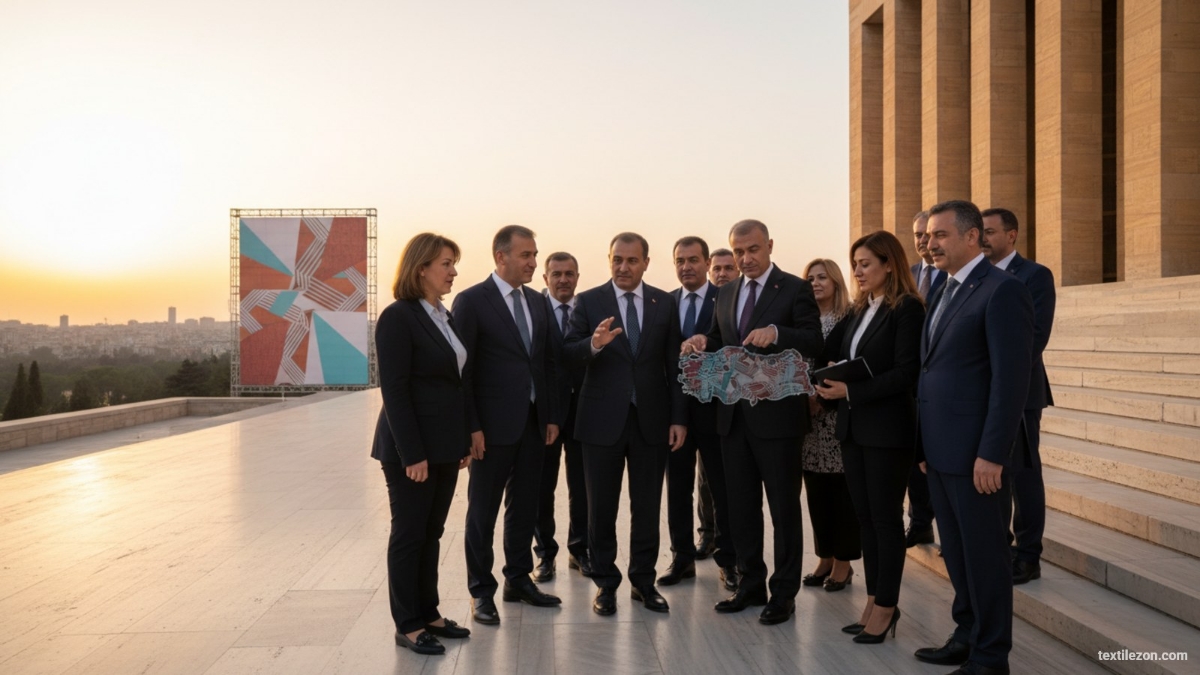
The celebrations opened with a ceremonial visit to Anıtkabir, the mausoleum of Mustafa Kemal Atatürk in Ankara. TGSD's board members and association delegates laid a wreath at Atatürk's tomb and observed a moment of silence. The visit was followed by the TGSD 50th Anniversary Gathering, attended by private sector companies and non-governmental organizations.
Co-Chair Dr. Ümit Özüren inscribed a message in Anıtkabir's Special Register, pledging to strengthen the “Turkey Brand” alongside the garment sector's global ambitions. He wrote: “Our responsibility is to make our industry more competitive, qualified, sustainable, and powerful — and to carry the 'Turkey Brand' into the future with labor, knowledge, design, innovation, and entrepreneurship.”
Deindustrialization Risk: Turkey's Industrial Warning Signs
Co-Chair Toygar Narbay delivered a data-driven warning about Turkey's declining industrial capacity. He cited that the merchandise exports-to-GDP ratio fell from 27% in 2022 to below 18% by end-2025. Under the Medium-Term Program, this figure is projected to reach 16.4% by 2028 — well below the global benchmark of approximately 22–25%.
Narbay argued that Turkey must not abandon labor-intensive sectors like the Turkish garment industry. Instead, the path forward is to elevate them through higher productivity, stronger design capacity, advanced technology adoption, and greater brand value. He pointed to Europe's experience as a cautionary tale: decades of outsourcing production led to technology gaps, strategic dependencies, fragile supply chains, and significant job losses. China, by contrast, built high-tech and innovation capacity on top of its existing manufacturing base — not in place of it.
Narbay stated: “When a country's production base weakens, it loses not only today's capacity — tomorrow's design, technology, brand, and innovation possibilities also narrow.” For more on developments shaping the sector, visit our textile news coverage.
2026–2028 Stabilization: Policy Roadmap for Recovery
Narbay assessed the near-term outlook cautiously. Gulf region developments have redirected short-term orders toward Turkey, offering a temporary boost. However, he cautioned that a sharp year-end recovery is unlikely — the more realistic scenario is loss containment and gradual stabilization. If internal and external conditions hold, the Turkish garment sector could emerge above the waterline in the second half of 2025.
Narbay identified 2026 as a potential repositioning threshold for the sector, provided the right policy steps are taken. He outlined the following priorities for the critical 2026–2028 stabilization period:
- 10% currency conversion support for net exporters
- Regionally differentiated TL 3,500 worker support — rising to TL 6,000 for Zone 6, with a 3% tolerance margin
- Rediscount rates set at 50% of the policy rate, with end-of-period interest collection
- KGF-backed guarantees for Eximbank credit facilities
- Reduction of raw material cost burdens
- Simplified Inward Processing Relief (DİR) procedures
These measures, Narbay emphasized, extend well beyond short-term fixes. They are designed to generate the financial resources needed for Turkey's post-2028 industrial transformation and sustained long-term competitiveness.
Frequently Asked Questions
What is TGSD and what does its 50th anniversary signify?
TGSD (Türkiye Giyim Sanayicileri Derneği) is Turkey's umbrella professional association for clothing manufacturers. Its 50th anniversary marks five decades of industry leadership and signals a renewed commitment to advancing the “Turkey Brand” and the sector's global standing.
What deindustrialization risk did TGSD leadership highlight?
Turkey's merchandise exports-to-GDP ratio dropped from 27% in 2022 to below 18% by end-2025, against a global benchmark of roughly 22–25%. This trend reveals a weakening industrial base that threatens Turkey's future capacity for design, technology, brand development, and innovation in the garment sector.
What policies does TGSD recommend for sector recovery?
TGSD calls for six key measures: net exporter currency support, regionally scaled worker subsidies, lower rediscount rates, KGF-backed Eximbank guarantees, reduced raw material costs, and simplified inward processing (DİR) procedures. These steps target the 2026–2028 stabilization window and aim to fund the sector's longer-term post-2028 transformation.
TGSD's 50th anniversary set a clear agenda: defend Turkey's industrial base, elevate the Turkish garment industry through innovation and brand value, and secure the policy conditions for sustained global competitiveness. The 2026–2028 stabilization period will be decisive for whether Turkey's apparel sector reclaims its position in global supply chains.