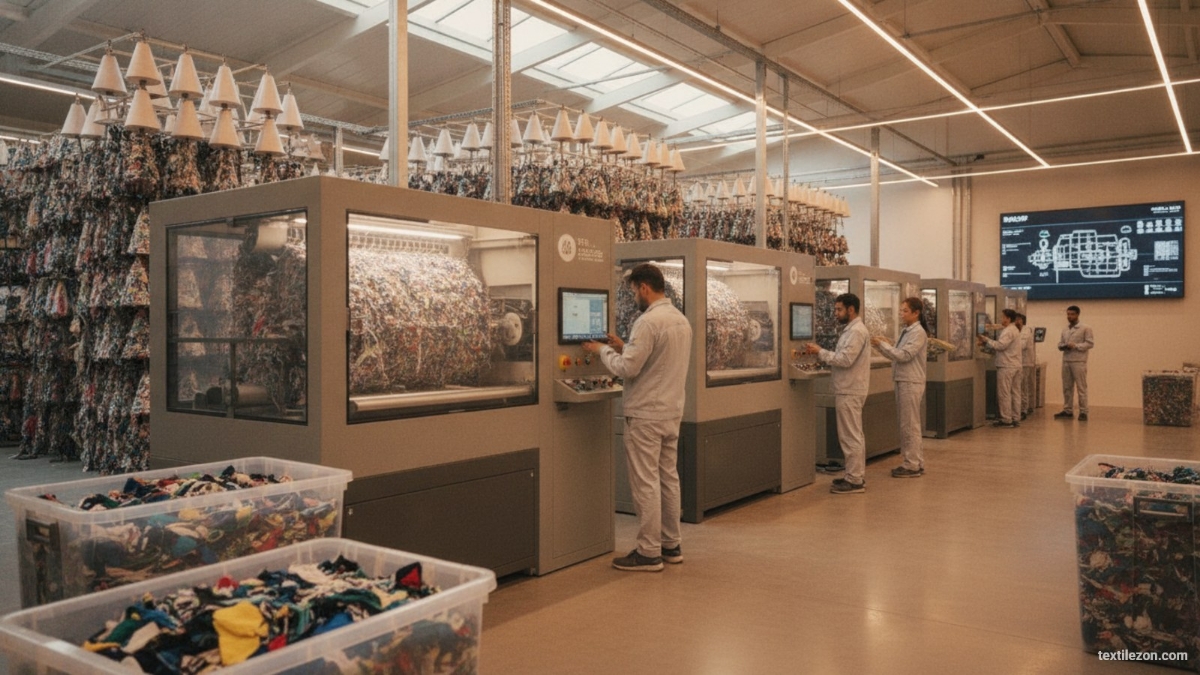
Recycled textiles are entering a new phase of industrial-scale adoption. RE&UP has officially launched the RE&UP Fiber Club, a collaborative fiber consortium built to remove the commercial and logistical barriers that have long kept circular fashion confined to limited pilot programs. Developed with innovation platform Fashion for Good, the initiative gives brand partners a structured, de-risked pathway into sustainable fiber sourcing.
What Is the RE&UP Fiber Club?
The Fiber Club is a consortium framework linking brands, suppliers, and recyclers under a shared operational model. Originally conceptualized by Fashion for Good and now active through RE&UP's recycling infrastructure, the program targets brands ready to commit to long-term recycled textile procurement at volume. It moves participants from one-off sustainability experiments into a permanent circular supply chain.
Three persistent obstacles have blocked widespread circular sourcing: fragmented logistics, high minimum order quantities, and significant upfront costs. By pooling demand across multiple brand partners, the consortium creates the commercial scale needed to make recycled fiber economically viable for mainstream production.
The Four-Phase Consortium Framework
The Fiber Club guides brand partners through four structured operational phases. Brands move sequentially through each stage before securing permanent recycled textile supply agreements.
- Phase 1 — Consortium Setup: Establishing the collaborative structure and aligning key stakeholders across the supply chain.
- Phase 2 — Material Sampling: Standardized testing of recycled fiber materials against brand quality requirements.
- Phase 3 — Pilot Collection Development: Small-scale production runs that validate integration with existing manufacturing workflows.
- Phase 4 — Long-Term Commitments: Securing predictable, discounted fiber purchase agreements for ongoing production cycles.
This four-phase progression transitions brands into a permanent circular supply chain with stable pricing and reduced procurement risk.
Commercial Alignment: The Missing Link in Textile Recycling
Andreas Dorner, General Manager of RE&UP, stressed that the technology for processing post-consumer textiles already exists. The real obstacle has been commercial alignment — building the demand signals and contractual frameworks that justify industrial-scale recycled textile production. The Fiber Club provides exactly that infrastructure, enabling forward-thinking brands to move past experimentation and begin scaling circular sourcing in earnest.
For B2B buyers and procurement managers, the consortium model lowers minimum order thresholds, spreads development costs across participants, and delivers supply security through long-term commitments. These factors directly reduce the sourcing risk that has historically discouraged brands from integrating recycled textiles as a standard manufacturing input. For ongoing updates on circular sourcing developments, visit the textile news section on textilezon.com.
Frequently Asked Questions
What is the RE&UP Fiber Club?
The RE&UP Fiber Club is a collaborative fiber consortium that provides brands with a structured four-phase pathway to integrate recycled textiles into large-scale production. Developed with Fashion for Good, it eliminates the commercial and logistical barriers that have historically limited circular fiber sourcing.
What barriers does the Fiber Club address?
The initiative targets three core obstacles: fragmented logistics, high minimum order quantities, and significant upfront costs. By pooling brand demand within a consortium, it creates the commercial scale needed to make recycled fiber procurement economically viable at volume.
Which companies should consider joining the Fiber Club?
The Fiber Club suits manufacturers and brands ready to move beyond pilot sustainability projects. It is especially valuable for B2B sourcing professionals seeking predictable, discounted access to high-quality recycled textile materials for ongoing industrial production runs.
The RE&UP Fiber Club establishes a replicable model for mainstreaming circular material sourcing across the global textile industry. As brand participation and long-term commitments grow, recycled textiles will increasingly become a standard manufacturing input — not a premium exception reserved for capsule collections.