Garment support devices are the hidden structural elements that give clothing its shape, fit, and function. From the underwire in a bra to the collar stay in a dress shirt, these components work beneath the surface to maintain structure across thousands of wear cycles. Understanding their types, materials, and mechanics is essential for every apparel manufacturer and textile procurement professional.
Table of Contents
- What Are Garment Support Devices?
- Types of Garment Support Devices
- Materials Used in Support Devices
- How Garment Support Devices Work
- Sourcing and B2B Procurement Considerations
- Quality Standards and Testing
- Frequently Asked Questions
- Key Takeaways
What Are Garment Support Devices?
Garment support devices are structural components embedded in or attached to clothing to maintain shape, provide lift, or control movement. They differ from decorative trims and functional fasteners because their primary role is structural. Without them, many garments would lose their intended silhouette within hours of wear.
These devices operate across virtually every apparel category. Intimate apparel relies heavily on underwires and molded cups. Tailored outerwear depends on shoulder pads and chest canvas. Formal shirting uses collar stays and collar bones to maintain crisp geometry through extended wear.
Each support device is engineered to solve a specific structural challenge in garment construction. Material selection, dimensional tolerances, and attachment method all affect the final garment's performance and commercial longevity.
Types of Garment Support Devices
Garment support devices fall into several categories based on function, placement, and target garment type. Each category applies different engineering principles to achieve its structural objective.
Underwires
Underwires are semi-rigid arched components sewn into the base of bra cups. They provide lift, separation, and shape to the bust. Most commercial underwires are made from tempered steel or nylon-coated steel, with wire diameters typically ranging from 0.8 mm to 1.2 mm.
The wire is encased in a fabric or plastic channel before insertion into the garment. This casing prevents wire breakthrough—one of the most costly quality failures in bra manufacturing. Underwires are available in more than 30 standardized size profiles to match cup and band combinations across size runs.
Leading suppliers produce underwires in bulk spools or pre-cut arches, depending on production volume and automation level at the manufacturing facility.
Shoulder Pads
Shoulder pads build out the shoulder silhouette in jackets, blazers, coats, and structured dresses. They correct natural shoulder asymmetry and give garments a cleaner, more authoritative drape. Typical shoulder pads consist of polyurethane foam or polyester batting sandwiched between nonwoven or woven fabric layers.
Shoulder pad thickness ranges from 4 mm for soft tailoring to over 25 mm for dramatic fashion silhouettes. Construction types include raglan pads, shirt pads, and structured suiting pads. They attach by sewing or by hook-and-loop fasteners for easy removal during laundering.
Collar Stays and Collar Bones
Collar stays are flat strips inserted into the undercollar of dress shirts to prevent collar points from curling. Common materials include polypropylene, stainless steel, and brass. Each material offers different rigidity and weight characteristics suited to different shirt constructions.
Collar bones for jacket lapels maintain the roll line and prevent the collar from flipping outward. These are typically woven interfacing tape or thin thermoplastic strips sewn into the lapel seam. Correct positioning relative to the gorge line is critical for a clean, consistent lapel roll.
Boning and Corset Stays
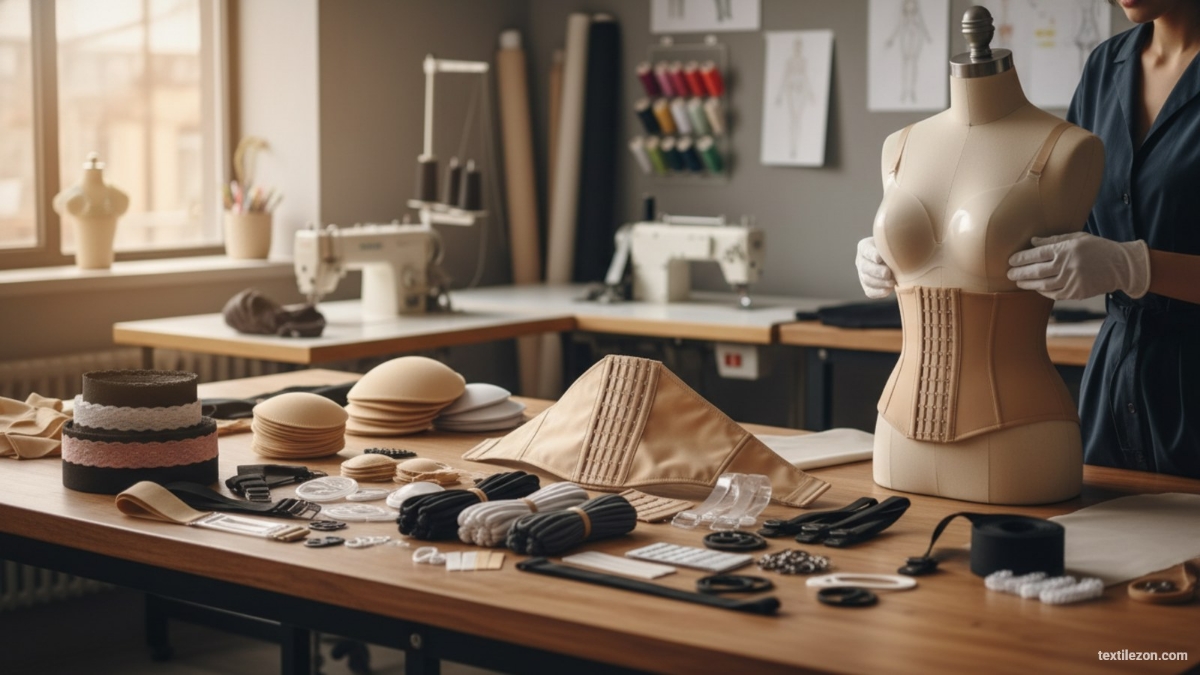
Boning refers to narrow rigid or semi-rigid strips inserted vertically into bodices, corsets, and structured evening wear. Modern boning uses spiral steel, flat steel, or flexible polypropylene. Each type offers a different rigidity-to-flexibility ratio suited to different garment styles and construction methods.
Spiral steel boning flexes in multiple directions and is preferred for curved seams in corsets and dance costumes. Flat steel boning provides maximum rigidity and is standard at center fronts and center backs. Plastic boning is lighter and rust-proof, making it suitable for swimwear and garments exposed to sustained humidity.
Boning is inserted into pre-formed channels or casings stitched directly to the garment. Channel widths must match boning widths precisely—standard sizes are 6 mm, 8 mm, 10 mm, and 12 mm—to prevent movement and puckering in the finished garment.
Swimwear and Lingerie Support Structures
Swimwear presents unique structural challenges because support devices must withstand repeated exposure to chlorine, saltwater, and UV radiation. Swimwear support devices include soft cups, molded foam cups, gripper elastic, and corrosion-resistant coated underwires.
Coated underwires for swimwear are encased in nylon or polyester to resist corrosion. Molded foam cups are typically 100% polyurethane, bonded with heat-activated adhesive rather than sewn construction. Gripper elastic is applied to leg openings and necklines to prevent the suit from shifting during movement.
Chest Canvas and Structured Interlinings
Chest canvas is a structured interlining used in premium tailored jackets and overcoats. It consists of layers of horsehair canvas, felt, and cotton duck, hand-stitched or fused to the jacket front. Chest canvas creates the lapel roll and gives the jacket front its three-dimensional drape.
Fused interlinings—where the support layer is bonded to shell fabric with thermoplastic adhesive—are the cost-effective alternative used in most commercial tailoring. Fused construction is faster to produce but may delaminate after repeated dry cleaning. Sewn canvas has a significantly longer functional lifespan and remains the benchmark for bespoke and premium ready-to-wear.
Materials Used in Support Devices
Material selection determines a support device's performance, durability, and compatibility with the host garment. The most common materials in commercial garment support manufacturing are:
- Tempered steel: High durability for underwires and flat boning; susceptible to corrosion without a protective coating.
- Nylon-coated steel: Industry standard for everyday bra underwires; coating prevents breakthrough and resists corrosion.
- Spiral steel: Multi-directional flexibility ideal for curved corsets and dance costumes.
- Polyurethane foam: Lightweight and moldable; typical garment grades range from 25 to 45 kg/m³ in density for shoulder pads and molded cups.
- Polypropylene: Rigid, lightweight, and chemical-resistant; used in collar stays and soft boning applications.
- Woven interfacing: Provides dimensional stability for collar bones and lapel support strips.
- Horsehair canvas: Traditional chest canvas material; breathable and resilient over long garment lifecycles.
Many manufacturers now evaluate recycled polyester and bio-based polyurethane alternatives to meet growing ESG reporting requirements from major retail buyers. Any material substitution must be re-tested to confirm that performance specifications are fully maintained before production rollout.
How Garment Support Devices Work
The structural mechanics of garment support devices rely on three core engineering principles: load distribution, rigidity control, and shape memory. Each principle applies differently across device categories.
Underwires distribute the load of the bust across the wire arch, transferring weight to the bra band rather than the shoulder straps. Wire stiffness must be calibrated to cup size—larger cups require higher gauge wires to prevent deformation under sustained load.
Shoulder pads fill the negative space between the natural shoulder slope and the garment's desired silhouette. Foam density controls how much space is filled and how the pad responds to movement. Higher-density foam maintains shape longer but may restrict movement; lower-density foam is more comfortable but deforms faster under regular wear.
Boning in corsets and bodices prevents fabric from collapsing under external pressure and distributes that pressure along the bone's full length. Spiral bones resist the torque forces that arise when the wearer twists; flat bones resist bending in a single plane only. Collar stays prevent the crimp energy stored in collar points from releasing as a visible curl, maintaining clean visual geometry through extended wear.
Sourcing and B2B Procurement Considerations
For apparel manufacturers and procurement teams, B2B sourcing of garment support devices requires managing precise specifications, lead times, and supplier qualifications. These are engineering components with tight tolerances—not commodity textiles—and specification errors carry real cost consequences at scale.
Key procurement parameters include:
- Wire gauge and profile: Underwires must match size charts precisely; deviations as small as 0.5 mm affect fit and consumer comfort.
- Foam density (kg/m³): Shoulder pad and cup performance depends directly on foam density specification at the component level.
- Minimum order quantities (MOQs): Many suppliers set MOQs at 500–2,000 units per SKU for standard profiles across size runs.
- Lead times: Custom-molded components typically require 60–90 days from confirmed order to delivery.
- Certification requirements: OEKO-TEX Standard 100, REACH compliance, and product-specific test reports are mandatory for European and North American retail supply chains.
China, South Korea, and Taiwan dominate global supply of garment support devices. Vietnam and Bangladesh are emerging alternative supply bases for foam-based components. Procurement teams can access broader sourcing intelligence through the Info Center on textilezon.com.
Quality Standards and Testing
Quality failures in support devices—underwire breakthrough, boning channel splitting, shoulder pad delamination—generate some of the most costly returns in finished garment manufacturing. Rigorous incoming quality control (IQC) for support components is a non-negotiable requirement for any volume apparel operation.
Standard tests for garment support devices include:
- Wire fatigue testing: Underwires are cycled through flexion tests (typically 10,000 cycles) to simulate wear; pass criteria require no visible deformation or coating failure.
- Corrosion resistance: Salt spray testing per ISO 9227 for coated metal components; minimum 24 hours for standard apparel, 48+ hours for swimwear applications.
- Compression set testing: Foam components are compressed to 50% of thickness for 22 hours at 70°C; recovery must exceed 80% to meet performance standards.
- Colorfastness: Non-white support devices must meet ISO 105-C06 laundering standards to prevent staining adjacent fabrics.
- Dimensional stability: Interfacing and collar bones must maintain tolerances within ±2% after three wash cycles.
Aligning on test methods at the specification stage—referencing AATCC and ISO standards by number—prevents disputes during production and final shipment inspection. Explore more technical apparel content in the textilezon.com articles section.
Frequently Asked Questions
What is the difference between boning and underwire in garment construction?
Boning is a general term for rigid or semi-rigid strips used in bodices, corsets, and structured garments to maintain shape under pressure. Underwire is a specific curved form of boning engineered for bras to support and lift the bust. Underwires are always arched to match cup geometry; general boning is typically straight or gently curved.
What materials are most commonly used for underwires in commercial bra production?
Nylon-coated tempered steel is the industry standard for commercial underwires. The steel core provides stiffness and fatigue resistance; the nylon coating prevents corrosion and reduces wire breakthrough risk. Premium bras may use titanium or carbon fiber underwires for reduced weight and superior corrosion resistance.
How do manufacturers prevent underwire breakthrough in finished bras?
Underwire breakthrough is prevented through correctly sized casings, smooth wire ends free of burrs, and reinforcing fabric patches at tack points. Quality control teams inspect wire ends before insertion, and seam allowances at channel endpoints are reinforced with bartacks or box stitching to contain the wire under sustained wear stress.
What are the key differences between fused and floating chest canvas in tailored jackets?
Floating (sewn-in) chest canvas is stitched to the jacket shell and moves independently, allowing the fabric to drape naturally over years of wear. Fused canvas is bonded with thermoplastic adhesive—faster and cheaper to produce but prone to delamination after repeated dry cleaning. Sewn canvas maintains performance over a significantly longer garment lifecycle and remains the standard in bespoke tailoring.
What certifications should B2B buyers require from garment support device suppliers?
Buyers supplying European or North American retail should require OEKO-TEX Standard 100 for all skin-contact components, REACH compliance documentation for restricted substances in metal parts, and ISO 9001 certification from the supplier's production facility. Swimwear support components should additionally include chlorine resistance and UV stability test reports as part of the commercial specification package.
Key Takeaways
Garment support devices are precision engineering components that directly determine the shape, fit, and commercial longevity of finished apparel. Selecting the correct device type, material, and specification for each garment application is a technical decision with measurable impact on product performance and retail return rates.
- Underwires, shoulder pads, boning, and collar stays each serve distinct structural functions requiring material-specific engineering and sourcing discipline.
- Material selection drives garment care requirements, durability, and sustainability credentials across the full product lifecycle.
- B2B procurement requires close attention to dimensional tolerances, MOQs, lead times, and certification standards for each component SKU.
- Rigorous quality testing—wire fatigue, corrosion resistance, compression set, and dimensional stability—is the primary defense against costly returns at retail.
- Leading suppliers are concentrated in East and Southeast Asia, with Vietnam and Bangladesh growing as alternative supply bases for foam-based support components.
Apparel brands and manufacturers who treat garment support devices as strategic components gain measurable advantages in product quality, fit consistency, and retail buyer satisfaction. Explore more technical apparel manufacturing insights in the textilezon.com articles section.