Flame retardant fibres are a critical performance category in modern mattress manufacturing. Precision Textiles, a component supplier to the bedding industry, completed a full day of open-flame mattress burn testing at its Arizona facility in February. The results confirmed consistent, reliable performance across multiple latex mattress constructions—including some of the most demanding elevated fuel-load configurations evaluated under CFR 1633. Bedding manufacturers relying on FR highloft components for compliance can use these validated results as a meaningful performance benchmark.
For procurement professionals and product developers navigating flammability compliance, understanding how FR highloft materials perform under standardized testing conditions is essential. Explore more technical resources in the articles section of textilezon.com.
Table of Contents
- Why Flame Retardant Compliance Matters in Bedding
- Precision Textiles' Arizona Manufacturing Facility
- PurLoft Organic: FR Highloft for Demanding Applications
- Understanding CFR 1633: The Federal Flammability Standard
- February Burn Test Results and Key Findings
- FR vs. Non-FR Highloft: Selecting the Right Fibre
- Frequently Asked Questions
- Key Takeaways for Bedding Manufacturers
Why Flame Retardant Compliance Matters in Bedding
The mattress industry operates under strict federal flammability regulations in the United States. These rules exist because mattresses represent one of the most significant fire hazards in residential environments. CFR 1633, the federal standard for mattress flammability, requires manufacturers to demonstrate that their products withstand sustained open-flame exposure without rapid ignition or uncontrolled fire spread.
Compliance is not optional—every mattress sold in the U.S. must meet CFR 1633 requirements before reaching consumers. For manufacturers, this means sourcing components, especially inner layers and border materials, that reliably pass full-scale burn tests. A failed test does not just delay a product launch; it triggers costly material redesigns and compliance retesting cycles.
FR fibres play a central role in meeting these standards. Highloft fibre solutions used in mattress panels and borders act as a protective barrier, limiting the rate at which a mattress ignites and propagates flame. Selecting the right FR fibre is therefore both a performance decision and a regulatory imperative for every bedding manufacturer selling in the U.S. market.
Precision Textiles' Arizona Manufacturing Facility
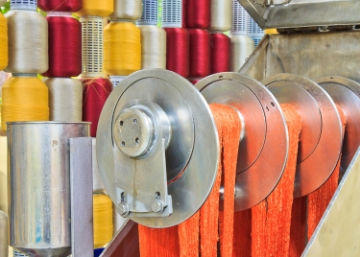
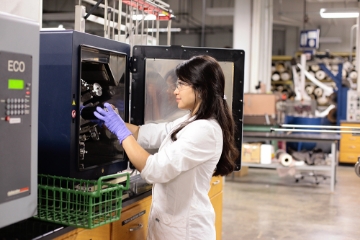
Precision Textiles operates a 60,000-square-foot manufacturing and warehouse facility in Arizona, established to meet increasing demand while positioning production closer to West Coast customers. The company built this operation as a strategic expansion of its U.S. manufacturing footprint. The facility has been producing FR and non-FR highloft solutions since 2021.
Since opening, the Arizona plant has focused on highloft solutions for mattress panels and borders, alongside a range of additional products. This broad production capability gives the facility versatility across product lines and customer specifications. The integrated manufacturing and warehousing layout supports efficient movement from production to distribution.
"The Arizona facility is doing exactly what we built it to do. We're seeing strong production output, high efficiency and consistent product performance. Just as important, we're in a great position to support additional volume and respond quickly to our West Coast customers." — Keith Martin, Vice President, Precision Textiles
Production Capabilities and Strategic Positioning
The 60,000-square-foot footprint accommodates both manufacturing and warehousing under one roof. This integrated layout allows Precision Textiles to move efficiently from production to distribution, reducing lead times for West Coast customers. High output consistency and operational efficiency are the two metrics Keith Martin identified as defining the facility's core performance.
For bedding manufacturers operating on tight compliance timelines, a reliable FR fibre supplier with fast West Coast distribution capability is a critical supply chain advantage. The Arizona facility's stated capacity to support additional volume further strengthens its position as a scalable supply partner for growing bedding brands.
PurLoft Organic: FR Highloft for Demanding Mattress Applications
PurLoft Organic is an FR highloft product manufactured at the Arizona facility, designed for mattress panels and borders where CFR 1633 compliance is required. Its organic positioning aligns with growing consumer and retailer demand for more transparent, cleaner material inputs in bedding products. PurLoft Organic addresses both the compliance and sustainability dimensions of modern mattress construction in a single material solution.
During the February burn testing, multiple latex mattresses incorporating PurLoft Organic were evaluated under CFR 1633. Several constructions featured elevated fuel loads—among the most demanding test scenarios under the standard. PurLoft Organic demonstrated consistent performance across all evaluated configurations without exception.
For mattress manufacturers sourcing FR components, consistent performance across high fuel-load constructions is a key differentiator. A material that passes only under baseline or ideal conditions provides limited assurance for real-world product lines. PurLoft Organic's results across demanding configurations indicate robust, repeatable compliance performance at production scale.
Organic Fibre and Flame Retardant Performance: Meeting Dual Requirements
Combining organic fibre sourcing with effective flame retardant performance presents a recognized technical challenge. Conventional FR treatments can conflict with organic material certifications, forcing manufacturers to choose between compliance and clean-label positioning. PurLoft Organic integrates FR performance without compromising the organic integrity of its fibre base.
This positions PurLoft Organic at the intersection of two important market trends: regulatory compliance and responsible sourcing. For manufacturers targeting health-conscious consumers or sustainability-focused retail channels, this fibre provides a material solution that satisfies both requirements simultaneously.
Understanding CFR 1633: The U.S. Federal Flammability Standard
CFR 1633 is the primary federal regulation governing mattress flammability in the United States, enforced by the Consumer Product Safety Commission (CPSC). It requires mattresses to be tested under open-flame conditions that simulate a sustained ignition source. The standard measures both peak heat release rate and total heat release over a defined evaluation window.
A mattress must not exceed a peak heat release rate of 200 kilowatts or a total heat release of 15 megajoules in the first 10 minutes of testing to achieve compliance. These thresholds reflect real-world fire scenarios and are designed to give building occupants adequate evacuation time. Full-scale burn testing of complete mattress assemblies is the only accepted method for demonstrating CFR 1633 compliance.
Elevated fuel-load constructions—such as those using latex cores—present a more demanding compliance challenge. Latex is a naturally flammable material that can significantly accelerate heat release during testing. FR barriers and highloft solutions must compensate for this increased fuel contribution to keep heat release within allowable CFR 1633 limits.
Test Complexity and Compliance Risk Management
Not all mattress constructions carry equal burn test risk. Higher-loft, latex-core, or pillow-top designs present greater compliance risk because of elevated fuel content. Testing these constructions requires FR materials that perform under elevated thermal stress—not just in baseline compliance scenarios.
Precision Textiles' February tests specifically targeted constructions with elevated fuel loads. This deliberate focus on difficult configurations confirms that PurLoft Organic is validated for the most demanding compliance scenarios available under CFR 1633. For manufacturers building complex or premium mattress lines, this validation is directly applicable to their compliance planning process.
February Burn Test Results: Consistent FR Performance Confirmed
Precision Textiles completed its full-scale open-flame burn testing in February, evaluating multiple latex mattresses incorporating PurLoft Organic produced at the Arizona facility. All tested constructions used Arizona-manufactured materials, providing direct validation of the facility's production output quality. The results confirmed consistent performance across every evaluated configuration.
The testing specifically targeted constructions with elevated fuel loads—representing CFR 1633 compliance scenarios where the underlying mattress core contributes significantly to potential heat release. Consistent performance in these scenarios validates PurLoft Organic as a reliable FR highloft solution for demanding bedding applications.
For bedding manufacturers, the significance of these results extends beyond a single test event. Consistent outcomes across multiple constructions and fuel-load levels indicate that the Arizona facility's production processes deliver uniform material properties. Batch-to-batch consistency is essential for maintaining CFR 1633 compliance across an entire production run—not just during initial certification samples.
What Consistent Production Performance Means for Compliance
CFR 1633 certification is conducted on specific mattress samples, but compliance must apply to every unit a manufacturer produces. If a fibre component's properties vary between production batches, manufacturers face ongoing compliance uncertainty and potential re-certification requirements. Consistent production quality reduces this risk and supports a more predictable compliance program across production volumes.
Strong production output, high efficiency, and consistent product performance are the three operational metrics Keith Martin highlighted from the Arizona facility. Each of these qualities translates directly into supply reliability and compliance assurance for Precision Textiles' bedding industry customers.
FR vs. Non-FR Highloft: Selecting the Right Fibre for Your Construction
Precision Textiles produces both FR highloft and non-FR highloft solutions at its Arizona facility, providing bedding manufacturers with options suited to different construction strategies. Understanding the distinction between these product types is essential when making fibre sourcing decisions aligned with CFR 1633 compliance requirements.
FR highloft solutions are appropriate when the fibre layer serves as the primary or supporting flame barrier within the mattress construction. These materials must demonstrate CFR 1633 compliance as part of a complete mattress assembly test. Non-FR highloft solutions are used where a separate FR barrier system—such as a treated ticking or dedicated FR sock—handles the compliance requirement for the overall construction.
When FR Highloft Is the Correct Choice
FR highloft is required when the mattress design relies on the comfort or border layer to achieve CFR 1633 compliance. This is common in constructions where a dedicated FR sock or separate barrier is not used as an independent compliance component. In these designs, the highloft material itself must carry the full compliance burden through the burn test evaluation.
Latex mattresses are a typical application for FR highloft given latex's inherent flammability and elevated fuel contribution to testing. PurLoft Organic's February burn test results confirm its suitability for exactly this demanding application, across multiple construction types and elevated fuel-load scenarios.
When Non-FR Highloft Is Appropriate
Non-FR highloft is appropriate when another mattress component provides the required flame barrier. A manufacturer using a separate FR sock or FR-treated ticking fabric may opt for non-FR highloft in comfort or transitional layers. This approach can offer material cost advantages while maintaining overall CFR 1633 compliance through system-level construction design.
The choice between FR and non-FR highloft depends on the complete mattress construction and the compliance strategy in use. Fibre suppliers like Precision Textiles can help manufacturers evaluate which solution fits their specific product and compliance architecture most effectively.
Frequently Asked Questions
What is CFR 1633 and why is it mandatory for mattress manufacturers?
CFR 1633 is the U.S. federal flammability standard for mattresses, enforced by the Consumer Product Safety Commission. It requires all mattresses sold in the United States to pass open-flame burn tests measuring peak heat release rate and total heat release. Non-compliance means a product cannot legally be sold in the U.S. market, making CFR 1633 a non-negotiable compliance threshold for all bedding manufacturers.
What is PurLoft Organic and how does it meet FR performance requirements?
PurLoft Organic is a flame retardant highloft fibre product manufactured by Precision Textiles at its Arizona facility. It integrates FR performance with organic fibre sourcing, making it suitable for mattress panels and borders where CFR 1633 compliance is required. February burn test results confirmed consistent performance across multiple latex mattress constructions, including elevated fuel-load scenarios.
What does a full-scale open-flame mattress burn test involve?
A full-scale open-flame mattress burn test evaluates a complete mattress assembly under open-flame exposure conditions defined by CFR 1633. The test measures both peak heat release rate and total heat release over a defined evaluation period. Testing a complete mattress assembly—not isolated components—is the only method accepted for CFR 1633 compliance demonstration.
Why are elevated fuel-load constructions harder to pass under CFR 1633?
Elevated fuel-load constructions contain highly flammable materials, such as latex cores, that release more energy during a burn test. This makes it harder for FR barrier materials to limit heat release within CFR 1633's allowable thresholds. Successfully testing under elevated fuel-load conditions demonstrates that a material performs in the most demanding real-world compliance scenarios, not only under ideal conditions.
Why did Precision Textiles establish its Arizona manufacturing facility?
Precision Textiles established its 60,000-square-foot Arizona facility in 2021 to meet increasing demand and position production closer to West Coast customers. The facility produces both FR and non-FR highloft solutions for the bedding industry, along with a range of additional products. This geographic positioning enables faster response times and stronger service levels for manufacturers in western U.S. markets.
Key Takeaways for Bedding Manufacturers
FR fibre performance must be validated through rigorous, standardized burn testing—assumptions based on material specifications alone are not sufficient for compliance planning. Precision Textiles' February burn test results demonstrate that PurLoft Organic consistently meets CFR 1633 requirements, including under the elevated fuel-load conditions that define the most challenging compliance scenarios in the bedding industry.
- The Arizona facility's 60,000-square-foot operation has produced FR and non-FR highloft since 2021, with strong output and consistent product performance metrics.
- PurLoft Organic passed full-scale open-flame burn testing on multiple latex mattress constructions, including elevated fuel-load configurations.
- CFR 1633 compliance requires full-scale mattress assembly testing—component-level specifications alone do not establish regulatory compliance.
- Both FR and non-FR highloft options are available from the Arizona facility, supporting different mattress construction and compliance strategies.
- Consistent batch-to-batch production quality is essential for maintaining CFR 1633 compliance across a full production run, not only during initial certification testing.
Sourcing validated flame retardant fibre solutions from a proven, high-capacity supplier is one of the most effective steps bedding manufacturers can take to manage CFR 1633 compliance risk at scale. Precision Textiles' Arizona facility delivers compliant FR highloft with the West Coast distribution capability to serve manufacturers quickly and reliably across production volumes.