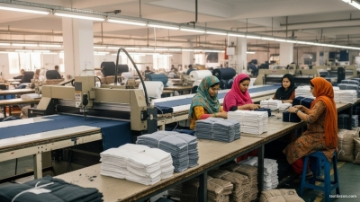
The apparel industry faces a persistent challenge: fabric waste generated during cutting and sewing stages consumes a significant portion of raw material budgets and contributes to pre-consumer textile waste. Artificial intelligence is changing this equation. By applying machine learning, computer vision, and generative design tools across the production workflow, manufacturers can now reduce fabric waste, improve material efficiency, and build more sustainable supply chains.
This article explores how AI technologies are transforming material utilization in apparel production, the specific tools driving change, and what B2B manufacturers need to consider before implementation.
- The Scale of Fabric Waste in Apparel Manufacturing
- AI-Powered Pattern Nesting and Cutting Optimization
- Predictive Demand Planning and Inventory Management
- Computer Vision for Quality Control and Defect Detection
- Generative AI in Design and Prototyping
- Challenges in AI Adoption for Garment Manufacturers
- Key Takeaways
- Frequently Asked Questions
The Scale of Fabric Waste in Apparel Manufacturing
Fabric waste is one of the largest hidden costs in garment production. Industry estimates suggest that cutting room waste alone can account for 15–20% of total fabric consumed in a typical manufacturing facility. At industrial scale, this figure translates into millions of metres of textile discarded before a single garment reaches the consumer.
Pre-consumer waste differs from post-consumer textile waste in a critical way: it can be reduced at the source. Optimizing pattern placement on fabric rolls, managing inventory more precisely, and detecting defects early in production are all intervention points where AI delivers measurable impact. The opportunity begins with better data and smarter algorithms.
For B2B buyers and manufacturers, the financial argument is as compelling as the environmental one. Fabric typically represents 60–70% of the total cost of goods in apparel production. Even marginal improvements in fabric utilization translate directly to improved margins.
AI-Powered Pattern Nesting and Cutting Optimization
Automated nesting is one of the most mature AI applications in garment manufacturing. Traditional manual marker-making — the process of arranging pattern pieces on fabric layouts — relies on skilled technicians and is highly time-intensive. AI-driven nesting software analyzes thousands of pattern placement combinations in seconds to find the most material-efficient arrangement.
How AI Nesting Works
Modern AI nesting systems use optimization algorithms, including genetic algorithms and constraint-based solvers, to maximize pattern pieces placed within a given fabric width. The software accounts for grain lines, stretch directions, pattern repeats, and fabric defects. The result is a computer-generated marker that consistently outperforms manual layouts in material utilization.
Leading CAD/CAM systems for apparel production have integrated AI-enhanced nesting as a core feature. These tools reduce cutting room fabric waste by several percentage points compared to purely manual approaches, delivering a rapid return on software investment for high-volume operations.
Automated Cutting and Real-Time Adjustment
AI capabilities extend beyond planning. Automated cutting systems equipped with machine learning detect fabric defects in real time and adjust pattern placement to avoid unusable sections. This prevents defective fabric from being embedded in cut parts, reducing costly downstream rework.
Integration between digital cutting systems and enterprise resource planning (ERP) platforms enables closed-loop feedback. Actual fabric consumption data feeds back into planning algorithms, continuously improving future marker efficiency and waste metrics.
Predictive Demand Planning and Inventory Management
A major source of fabric waste in apparel production is overproduction — manufacturing more than the market demands. Predictive demand planning powered by AI addresses this by analyzing historical sales data, seasonal patterns, and market signals to generate more accurate production forecasts.
When manufacturers produce closer to actual demand, they purchase less excess fabric upfront. This reduces both the financial risk of carrying unsold inventory and the waste associated with obsolete materials. AI-driven forecasting tools integrate with supply chain platforms to align fabric procurement with real-time sales data.
Beyond demand forecasting, AI also optimizes raw material ordering. Intelligent procurement systems calculate order quantities based on minimum order amounts, lead times, and production schedules, reducing overstocking and the fabric waste that accompanies it.
Computer Vision for Quality Control and Defect Detection
Computer vision systems are transforming fabric inspection in apparel production. Traditional manual inspection is slow, inconsistent, and prone to human error. AI-powered vision systems scan fabric at high speed, detecting weave defects, color inconsistencies, and surface irregularities with accuracy that human inspectors cannot match at industrial scale.
Inline Fabric Inspection
Inline inspection systems installed on fabric-spreading machines scan each layer before cutting begins. When a defect is detected, the system flags its location so the nesting software can route pattern pieces around it. This approach recovers usable fabric that would otherwise be scrapped due to defect contamination.
Manufacturers implementing inline AI inspection report measurable reductions in reject rates at the cutting stage. Catching defects before cutting eliminates the cost of processing defective cut parts through sewing and finishing operations.
End-of-Roll and Remnant Optimization
Computer vision tools also help manage end-of-roll remnants, a persistent source of waste in high-volume cutting operations. AI systems scan and catalogue remaining fabric lengths, then match them to smaller pattern pieces or orders that can be cut from remnants rather than new rolls. This remnant-matching capability significantly reduces the volume of short-roll fabric that would otherwise be discarded.
Generative AI in Design and Prototyping
At the design stage, generative AI enables apparel brands and manufacturers to reduce waste before production begins. Traditional sample development cycles involve multiple physical prototypes, each consuming fabric, labor, and time. AI-assisted design tools and 3D virtual prototyping platforms allow teams to visualize and refine garments digitally, dramatically reducing the number of physical samples required.
Generative design tools can also propose pattern alterations that improve fabric efficiency without compromising aesthetics or fit. By analyzing pattern geometry and fabric constraints, AI suggests seam line adjustments, dart placements, or style modifications that increase material utilization in the marker-making phase.
The shift toward digital-first sampling is particularly relevant for B2B manufacturers serving fast-fashion or trend-driven customers, where pressure to develop new styles rapidly is constant. Reducing physical sample rounds from five to two represents a proportional reduction in sampling fabric waste and development lead time.
Challenges in AI Adoption for Garment Manufacturers
Despite clear benefits, AI adoption in apparel manufacturing is not without barriers. Data quality and availability remain significant obstacles, particularly for small and medium-sized manufacturers in developing countries. AI systems require clean, structured production data to deliver reliable outputs. Many factories still rely on paper-based records or fragmented software that does not generate the data AI tools need.
Initial investment costs for AI-enabled CAD systems, automated cutting machines, and computer vision inspection lines are substantial. Return on investment depends heavily on production volume and the degree to which existing processes are already digitized. Manufacturers with lower volumes may find simpler interventions deliver better near-term returns.
Workforce skill gaps also present a challenge. Operating AI-integrated production systems requires a different skill set from traditional garment manufacturing. Training programs and change management are necessary components of successful implementation. Engineering institutions such as the National Institute of Textile Engineering and Research (NITER) in Bangladesh are actively developing talent equipped to bridge traditional textile education and AI-driven manufacturing practices.
Manufacturers exploring AI solutions for waste reduction can find further technical resources in the articles section at Textilezon, covering emerging production technologies across the apparel and textile value chain.
Key Takeaways
- Cutting room fabric waste can account for 15–20% of total material consumption in apparel factories, making it a high-priority target for cost and sustainability improvements.
- AI-powered nesting software optimizes pattern placement to maximize fabric utilization, consistently outperforming manual marker-making in material efficiency.
- Computer vision systems detect fabric defects inline, enabling real-time pattern rerouting and reducing reject rates before cutting begins.
- Predictive demand planning tools align fabric procurement with actual market demand, reducing overproduction and excess inventory waste.
- Generative AI and 3D prototyping tools reduce physical sample requirements, lowering fabric consumption at the design and development stage.
- Successful AI adoption requires investment in data infrastructure, equipment, and workforce training, with the strongest ROI in high-volume, digitized production environments.
Manufacturers that integrate AI across cutting, quality control, design, and planning workflows position themselves to achieve measurable reductions in fabric waste while strengthening cost competitiveness in a demanding global market.
Frequently Asked Questions
What is the most effective AI application for reducing fabric waste in apparel production?
AI-powered nesting and automated cutting optimization deliver some of the most direct and measurable reductions in cutting room fabric waste. These systems analyze thousands of pattern layout combinations to achieve optimal material utilization, consistently improving on manual marker-making processes in high-volume operations.
How does computer vision help reduce fabric waste during manufacturing?
Computer vision systems scan fabric layers in real time to detect defects before cutting begins. By mapping defect locations, the software routes pattern pieces around unusable sections and enables remnant fabric to be matched with smaller orders — both actions reduce the volume of fabric that is scrapped or wasted.
Can AI reduce fabric waste at the design stage, before production begins?
Yes. Generative AI and 3D virtual prototyping tools allow garment designers to refine styles digitally, reducing the number of physical samples needed. AI can also suggest pattern geometry changes that improve fabric yield during marker-making, addressing waste before any material is cut.
What challenges do manufacturers face when implementing AI for fabric waste reduction?
The main barriers are data quality, initial investment costs, and workforce skills. AI systems require structured production data to function effectively. Many factories, especially smaller operations in developing markets, lack the digital infrastructure to support AI-driven tools without prior investment in systems and staff training programs.
Is AI adoption for fabric waste reduction suitable for small and medium-sized garment manufacturers?
Smaller manufacturers can benefit from AI, but the strongest return on investment is typically seen at higher production volumes where efficiency gains compound across large fabric orders. SMEs may achieve better near-term results by starting with AI-assisted nesting software — often available as a subscription service — before investing in hardware-intensive systems like automated cutting and inline inspection.