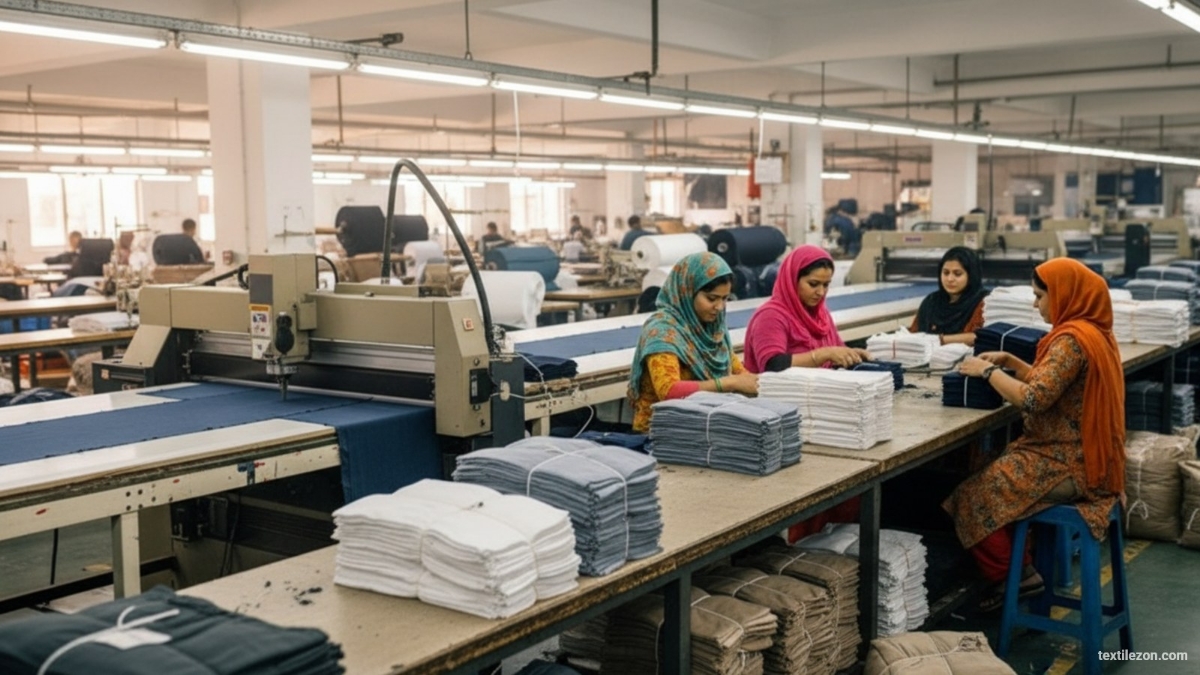
Fabric cutting is the foundation of every successful apparel production run. From single-ply custom orders to high-volume industrial layups, the cutting room determines garment quality, material efficiency, and downstream workflow speed. Mastering fabric cutting and bundling techniques directly reduces waste, ensures consistent sizing, and keeps sewing lines running without interruption.
Fabric costs typically represent 60–70% of total garment production expenses. Even a 1–2% improvement in cutting yield translates into measurable savings across thousands of units. For B2B apparel manufacturers and sourcing professionals, the cutting room is one of the highest-leverage areas for cost and quality improvement.
Table of Contents
- What Is Fabric Cutting in Apparel Production?
- Fabric Spreading and Layup Preparation
- Fabric Cutting Methods and Equipment
- Marker Planning and Fabric Utilization
- The Bundling Process in Garment Manufacturing
- Quality Control in Cutting Operations
- Optimizing Cutting Room Efficiency
- Frequently Asked Questions
What Is Fabric Cutting in Apparel Production?
Fabric cutting transforms flat textile material into the individual pattern pieces required for garment sewing. In industrial environments, cutting operations handle multi-ply layups of 50 to 200 fabric plies simultaneously. The accuracy of each cut directly affects seam allowances, garment fit, and overall product quality.
According to industry benchmarks, fabric accounts for 60–70% of total garment production costs, making cutting efficiency one of the highest-leverage improvement areas in any apparel operation. Cutting room decisions influence material waste, downstream sewing productivity, and defect rates in equal measure. Explore more technical production resources in the articles section of the textilezon.com Info Center.
Fabric Spreading and Layup Preparation
Before cutting begins, fabric must be spread evenly across the cutting table in aligned plies to a specified length and height. This process — known as fabric spreading or fabric layup — is critical to cut-piece consistency. Uneven tension or misaligned plies cause pieces to deviate from pattern dimensions across the full layup depth.
Key Spreading Considerations
- Ply direction: Fabrics are spread face-up/face-up, face-down/face-up, or nap-one-way (NOW) depending on fabric type and pattern requirements.
- Tension control: Consistent, relaxed tension prevents distortion. Over-stretched plies yield cut pieces smaller than the intended pattern dimensions.
- Splice allowances: When a fabric bolt ends mid-layup, splices must include sufficient overlap to guarantee full pattern coverage at the join point.
- Relaxation time: Knit and stretch-woven fabrics require 12–24 hours of resting after spreading to prevent shrinkage-related sizing errors in the finished garment.
Automated spreading machines increase throughput by up to 40% compared to manual spreading while maintaining precise ply alignment and consistent tension throughout the layup.
Fabric Cutting Methods and Equipment
The choice of cutting method depends on fabric type, layup height, production volume, and required precision. Industrial cutting rooms typically deploy multiple methods within a single style to match each operation to the most appropriate tool.
Straight Knife Cutting
The straight knife machine is the most widely used cutting tool in garment manufacturing. Its vertical reciprocating blade cuts through layups of 50–150 plies at high speed. Straight knife cutters handle both straight and curved lines but require skilled operators to maintain accuracy on complex pattern contours.
Band Knife Cutting
Band knife machines use a continuous-loop stationary blade while the operator feeds fabric through the cutting station. This method delivers high precision on small curved components such as collar stands, pocket flaps, and shaped cuffs. Band knife cutting is preferred when tight-radius shapes are required on finished pattern pieces.
Die Cutting
Die cutting uses shaped metal dies pressed through single or low-ply layups to stamp uniform components. It is ideal for small, repetitive pieces such as cuffs, waistbands, and pocket bags. Die cutting offers excellent repeatability but requires a dedicated die for each pattern shape, adding upfront tooling cost to the operation.
Computerized CNC Cutting Systems
CNC cutting systems use CAD-generated markers to drive automated cutting heads, achieving dimensional tolerances as tight as ±0.5 mm. These systems integrate with PLM and ERP platforms and have become standard equipment in high-volume apparel factories worldwide.
- Cutting speeds of up to 50 meters per minute
- Consistent cut quality across all plies without operator variability
- Real-time material usage reporting and automatic waste calculation
- Labor requirement reductions of up to 60% compared to manual cutting
Marker Planning and Fabric Utilization
A cutting marker is the optimized arrangement of all pattern pieces for a specific style, size ratio, and fabric width. The marker layout is printed or digitally projected onto the top ply to guide the cutting operation. Marker efficiency is the most controllable variable in fabric consumption per garment.
Marker Efficiency Benchmarks
Marker efficiency measures the percentage of the total marker area covered by usable pattern pieces. Current industry benchmarks by method are as follows:
| Marker Method | Typical Efficiency Range |
|---|---|
| Manual marker making | 75–82% |
| CAD-assisted marker making | 82–88% |
| AI-assisted automated nesting | 88–92% |
Improving marker efficiency from 80% to 85% on a 10,000-unit order consuming 1.5 meters per garment saves 750 meters of fabric. At $3 per meter, this represents $2,250 in material savings on a single cut order — without changing any other production parameter.
Grain Line Compliance
All pattern pieces must be placed on the marker with grain lines parallel to the fabric's lengthwise grain unless design specifications allow deviation. Off-grain cutting causes garments to twist, skew, or pucker after washing — a quality failure that drives customer returns and damages supplier reputation.
The Bundling Process in Garment Manufacturing
After cutting, fabric pieces are organized into bundles for transfer to sewing operations. A bundle groups all cut components needed to complete a defined assembly unit — typically one garment or a fixed batch quantity. Bundling accuracy directly determines WIP traceability and sewing line productivity.
Optimal Bundle Size Selection
Standard bundle sizes in industrial garment production range from 12 to 30 pieces. Several factors determine the right size for each style:
- Style complexity: Multi-panel styles benefit from smaller bundles to minimize component handling errors at sewing stations.
- Sewing line balance: Bundle size should align with individual operator cycle times to prevent WIP accumulation and bottlenecks.
- Floor space constraints: Larger bundles consume more work-in-progress storage area between operations, which conflicts with lean layout objectives.
Bundle Ticket Systems
Bundle tickets — also called work tickets or cut tickets — travel with each bundle through the entire sewing and finishing sequence. A complete ticket includes the style number, colorway, size, bundle number, ply reference, cut order number, and piece count.
Modern factories use barcoded or QR-coded bundle tickets for scan-based WIP tracking at every workstation. This provides real-time production visibility and enables supervisors to identify and resolve bottlenecks before they threaten delivery schedules.
Fused and Interlined Components
Pattern pieces requiring interlining — front bands, collar stands, cuffs, and waistbands — must be fused before bundling. Correct fusing temperature, pressure, and dwell time settings for each fabric and interlining combination are essential to bond integrity. Delamination in finished garments is a direct indicator of fusing process failures at this stage.
Quality Control in Cutting Operations
Detecting defects at the cutting stage prevents them from consuming additional labor, trims, and machine time at downstream sewing operations. A structured quality program in the cutting room is a core element of lean apparel manufacturing.
Cutting Room Quality Checkpoints
- Notch accuracy: Notch locations should fall within ±1 mm of pattern specifications. Inaccurate notches lead directly to seam misalignment during sewing assembly.
- Drill holes: Marking holes must penetrate all plies cleanly without scorching or heat damage, especially on heat-sensitive synthetic fabrics.
- Edge quality: Cut edges must be clean and fray-free, particularly on loosely woven structures with elevated seam slippage risk.
- Ply alignment: The layup should show no inter-ply shift greater than 3 mm between the top and bottom plies to ensure dimensional consistency across the bundle.
- Pattern matching: Stripe and check fabrics require cut-piece inspection for alignment compliance per design specifications before bundling proceeds.
Cutting rooms following ISO 9001 quality management principles implement first-piece inspection for every new layup and random sampling of 10–15% of all cut bundles before they advance to the sewing line.
Optimizing Cutting Room Efficiency
Continuous improvement in the cutting room reduces per-unit production costs and supports faster order fulfillment. Manufacturers implementing lean cutting operations consistently outperform industry averages on both material yield and throughput metrics.
- Digital pattern grading: Automated grading eliminates manual re-drafting errors and accelerates marker preparation across full size ranges.
- Multi-order splicing: Combining cut orders that share the same fabric and colorway in a single layup maximizes marker efficiency and reduces setup time per unit.
- Fabric waste recycling: Cutting room offcuts can be baled and sold to textile recyclers, recovering secondary material value and reducing disposal costs.
- Lean floor layouts: Continuous-flow arrangements of spreading, cutting, and bundling stations reduce material handling distances by 15–25%, lowering non-value-added time per unit.
Frequently Asked Questions
What is the ideal ply height for fabric cutting?
Optimal ply height depends on fabric weight, cutting method, and blade capacity. Straight knife cutting handles 50–150 plies for standard woven fabrics. Heavier materials such as denim or canvas typically require reduced layups of 30–60 plies to maintain cut accuracy throughout the full layup depth.
How do you prevent fabric shifting during cutting?
Fabric shift is controlled through consistent spreading tension, end clamp bars, and anti-slip base paper placed under the bottom ply. Slippery synthetic fabrics benefit from plastic film separators between plies. CNC cutting systems with integrated vacuum hold-down tables provide the most reliable solution for high-volume multi-ply layups.
What is marker efficiency and why does it matter?
Marker efficiency is the ratio of pattern piece area to total marker area, expressed as a percentage. Since fabric represents 60–70% of total garment production cost, each percentage point of efficiency improvement directly reduces cost per unit. AI-assisted nesting tools currently achieve 88–92% efficiency, compared to 75–82% for manual methods.
How should bundles be labeled for production tracking?
Each bundle should carry a ticket showing the style number, size, colorway, bundle number, ply reference, cut order number, and piece count. Barcoded or QR-coded tickets enable scan-based WIP tracking at each sewing station, supporting real-time monitoring and data-driven line balancing decisions.
What are the most common cutting defects and how are they prevented?
The most frequent defects include inaccurate notch placement, off-grain pattern pieces, ply shift distortion, and heat-damaged edges on synthetic fabrics. Prevention requires regular blade maintenance, calibrated spreading tension, first-piece inspection, and strict adherence to cutting SOPs. Computerized CNC systems eliminate most operator-variable defects at the cost of higher capital investment.
Key Takeaways
- Fabric cutting directly controls 60–70% of total garment production cost through material utilization efficiency.
- Spreading accuracy, marker planning, and cutting method selection are the three primary performance levers in the cutting room.
- Bundle ticket systems are essential for WIP traceability and effective sewing line management at any production scale.
- Quality checkpoints at the cutting stage prevent costly defects from advancing and consuming downstream labor and resources.
B2B apparel manufacturers and sourcing teams who invest in cutting room process discipline and technology build a measurable competitive advantage in cost efficiency, product quality, and on-time delivery performance.