Acetate fiber has a distinctive place in textile history. Cellulose acetate first served as a dope coating on WWI aircraft fabric wings, tightening and stabilizing the material under flight conditions. That early industrial role revealed the compound's unique film-forming properties, paving the way for decades of commercial fiber development.
Its chemical relative, triacetate fiber, shares the same cellulosic origin but carries a higher degree of acetylation. This seemingly small chemical difference creates meaningful performance distinctions in heat resistance, wash care, and dimensional stability. For textile manufacturers, sourcing professionals, and product developers, understanding these distinctions leads to better material decisions across garment and fabric applications.
- What Is Acetate Fiber?
- What Is Triacetate Fiber?
- Acetate vs Triacetate: Key Properties Compared
- How These Fibers Are Manufactured
- End Uses Across the Textile Industry
- Care and Maintenance Requirements
- Frequently Asked Questions
- Key Takeaways
What Is Acetate Fiber?
Acetate, formally known as cellulose diacetate, is a semi-synthetic fiber produced by chemically modifying cellulose derived from wood pulp or cotton linters. The manufacturing process reacts cellulose with acetic anhydride and acetic acid, replacing approximately two of three available hydroxyl groups per repeat unit. This partial substitution yields a degree of substitution (DS) of around 2.4 to 2.5.
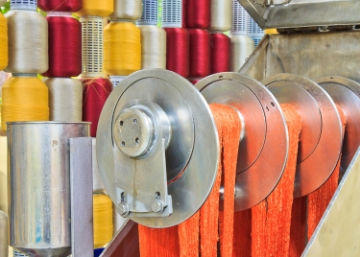
Because cellulose diacetate dissolves readily in acetone, it is processed through dry spinning. A concentrated dope of acetate dissolved in acetone is extruded through fine spinneret holes into a heated chamber. The solvent evaporates immediately, solidifying the filament before it is wound onto bobbins.
The result is a fiber with a silk-like luster, excellent drape, and a soft hand. Its relatively low wet-state strength and sensitivity to acetone-based solvents, however, limit its use in demanding performance applications.
Physical Profile of Acetate
- Density: approximately 1.32 g/cm³
- Moisture regain: 6.0–6.5% at standard conditions
- Dry tenacity: 1.2–1.4 g/denier
- Wet tenacity: approximately 60–70% of dry strength
- Softening point: approximately 230°C
- Soluble in acetone and ketone-based solvents
What Is Triacetate Fiber?
Triacetate, or cellulose triacetate (CTA), carries a higher degree of acetylation than diacetate. Nearly all three hydroxyl groups per cellulose unit are substituted, producing a DS approaching 3.0. This more complete acetylation makes triacetate significantly more hydrophobic and thermally stable than its diacetate counterpart.
Triacetate also uses dry spinning, but its higher DS requires different solvent systems — typically methylene chloride and methanol blends rather than pure acetone. The resulting fiber has a more crystalline molecular structure, which directly contributes to its improved dimensional stability and heat-setting performance.
The higher softening temperature is a decisive commercial advantage. Triacetate fabrics can be heat-set at temperatures above 200°C, permanently locking pleats and structural details into garments that survive repeated laundering without losing their form.
Physical Profile of Triacetate
- Density: approximately 1.30 g/cm³
- Moisture regain: 3.2–3.5% — roughly half that of acetate
- Dry tenacity: 1.0–1.2 g/denier
- Softening point: 290–300°C
- Resistant to acetone and most common textile solvents
- Excellent heat-setting capability for permanent pleating
Acetate vs Triacetate: Key Properties Compared
While both fibers originate from cellulosic chemistry, their real-world performance profiles diverge across several critical dimensions. The table below presents the most commercially significant comparisons for sourcing and product development decisions.
| Property | Acetate (Diacetate) | Triacetate |
|---|---|---|
| Degree of Substitution (DS) | ~2.4–2.5 | ~2.9–3.0 |
| Moisture Regain | 6.0–6.5% | 3.2–3.5% |
| Softening Point | ~230°C | ~290–300°C |
| Solvent Resistance | Low (dissolves in acetone) | High (acetone-resistant) |
| Wrinkle Recovery | Moderate | Good to Excellent |
| Heat-Setting Capability | Limited | Excellent |
| Recommended Wash Care | Dry clean | Machine washable (many grades) |
| Aesthetic Character | Silky, high luster | Crisp, moderate luster |
Thermal Behavior
Thermal response is one of the most commercially important differences between the two fibers. Acetate softens near 230°C and can glaze or distort under high ironing temperatures. Triacetate's softening range of 290–300°C gives fabric finishers far more latitude at the press and heat-setting frame.
This distinction directly shapes garment construction workflows. Triacetate enables permanently pleated designs that survive repeated wash-and-wear cycles without resetting. Acetate cannot be reliably heat-set and requires low-heat finishing to prevent surface damage and luster loss.
Moisture and Comfort Properties
Acetate's moisture regain of 6.0–6.5% means it absorbs noticeably more moisture than triacetate's 3.2–3.5%. This higher regain makes acetate feel cooler and more comfortable against the skin in warm wearing conditions. Triacetate's lower moisture absorption, while less favorable for comfort in heat, improves quick-drying performance and dimensional stability after laundering.
How These Fibers Are Manufactured
Both acetate and triacetate begin with dissolving-grade wood pulp — a highly purified cellulose derived from sustainably managed softwood forests. The pulp undergoes pre-treatment, acetylation with acetic anhydride, and — for diacetate — controlled partial hydrolysis before the spinning dope is prepared. Triacetate production omits the hydrolysis step, preserving the higher DS of the fully acetylated product.
The dry spinning process converts the polymer solution into continuous filament yarn. The dope is metered under pressure through a spinneret into a heated spinning cabinet. Hot air removes the solvent immediately upon extrusion, and the solidified filament is taken up by godets and wound onto packages. Fiber luster — bright, semi-dull, or dull — is controlled by the titanium dioxide concentration in the spinning formulation.
Sustainability Considerations
Acetate and triacetate both originate from renewable, plant-based cellulose — a meaningful advantage over petroleum-derived synthetic fibers. The acetylation chemistry consumes acetic acid and acetic anhydride, generating recovered acetic acid as a by-product that requires recapture and treatment. Responsible manufacturers operate closed-loop solvent recovery systems that reclaim the large majority of acetone used in diacetate spinning.
Biodegradability under ambient environmental conditions is more limited for both fibers than for unmodified natural cellulose. Buyers in sustainability-focused supply chains should verify suppliers' environmental management certifications and solvent recovery practices before finalizing sourcing commitments.
End Uses Across the Textile Industry
Acetate fiber and triacetate serve partially overlapping but distinctly different end-use markets. Their diverging performance profiles steer each fiber toward specific product categories where its strengths deliver the greatest commercial value.
Primary Applications of Acetate
- Garment linings: Acetate's silky hand and smooth drape make it the dominant lining material in tailored jackets, coats, and formal trousers.
- Lingerie and sleepwear: Its cool, smooth surface and luxurious appearance position it as a premium alternative to silk in intimate apparel.
- Eveningwear and bridal: Acetate satin and acetate taffeta deliver the high luster and structural body favored in formal occasion and wedding gown fabrics.
- Specialty filtration: Cellulose acetate tow is widely used in filtration applications, representing a major share of global acetate production volume.
Primary Applications of Triacetate
- Pleated skirts and structured garments: Heat-set pleats remain crisp and defined through multiple wash cycles — the defining commercial advantage of triacetate in apparel.
- Jersey and knitted fabrics: Triacetate knits offer good recovery, dimensional stability, and easy-care performance valued in mid-market knitwear.
- Sportswear and performance blends: Its solvent and heat resistance suits blended performance fabric constructions where durability is critical.
- Specialty nonwovens: Triacetate finds selective technical use in applications where cellulosic origin and moderate biodegradability are valued by specifiers.
Care and Maintenance Requirements
Correct care is essential for both fiber types. Improper laundering or dry cleaning practices can cause irreversible damage — particularly to acetate-based fabrics, which are vulnerable in both the wet state and under excessive heat.
Caring for Acetate Fabrics
- Dry cleaning is strongly recommended for most acetate garments, linings, and accessories.
- Hand washing in cold water below 30°C with a gentle, solvent-free detergent is acceptable for certain lighter items.
- Never wring or twist wet acetate — it loses significant tensile strength when wet and can deform permanently.
- Press on the lowest iron setting with a protective pressing cloth; avoid applying steam directly to the fabric surface.
- Keep acetate away from acetone-based products such as nail polish remover, which will dissolve the fiber on contact.
Caring for Triacetate Fabrics
- Many triacetate grades are machine washable on a gentle cycle in warm water up to 40°C.
- Tumble dry on a low heat setting; triacetate's low moisture regain promotes rapid drying.
- Iron at medium temperature settings — the higher softening point provides considerably more processing latitude than acetate allows.
- Heat-set pleats will retain their shape through normal domestic washing without any special pre-treatment or reshaping.
Frequently Asked Questions
Is acetate a natural or synthetic fiber?
Acetate is classified as a semi-synthetic or regenerated fiber. It originates from natural cellulose — typically wood pulp — but undergoes significant chemical transformation through acetylation. This places it in a distinct category from natural fibers like cotton and fully synthetic fibers like polyester or nylon.
What is the main difference between acetate and triacetate?
The primary difference is the degree of acetylation. Acetate (diacetate) replaces approximately 2 of 3 hydroxyl groups per cellulose unit, while triacetate replaces nearly all 3. This higher substitution gives triacetate superior heat resistance, better wrinkle recovery, acetone resistance, and machine-washability across most commercial grades.
Can acetate fabrics be machine washed?
Most acetate fabrics should not be machine washed. Acetate loses considerable tensile strength in the wet state and is prone to deformation and water spotting under agitation. Dry cleaning is the standard care recommendation. Triacetate is substantially more laundry-friendly and is rated machine washable in most commercial fabric grades.
Why does acetate dissolve in nail polish remover?
Acetone — the active solvent in many nail polish removers — is the same chemical used to dissolve cellulose diacetate during fiber production. Because acetate retains its solubility in acetone after spinning, direct contact with nail polish remover will dissolve or severely damage the fabric. Triacetate's higher degree of substitution makes it effectively resistant to acetone.
Are acetate and triacetate fibers sustainable options?
Both fibers derive from renewable plant-based cellulose, which differentiates them positively from petroleum-sourced synthetics. However, the acetylation chemistry involves acetic acid reagents, and biodegradability under ambient environmental conditions is more limited than for unmodified natural fibers. Sustainability-conscious buyers should assess supplier certifications, solvent recovery documentation, and raw material sourcing practices before finalizing procurement decisions.
Key Takeaways
- Acetate fiber traces its practical origins to WWI aircraft fabric coatings; today it is a commercially significant semi-synthetic fiber serving garment linings, eveningwear, and specialty filtration markets.
- Triacetate's higher degree of acetylation delivers superior heat resistance, wrinkle recovery, and solvent resistance compared to diacetate — at the cost of slightly lower moisture comfort.
- Acetate demands dry-clean care and must be protected from acetone exposure; triacetate supports machine washing and permanently retains heat-set pleats through repeated laundering.
- Material selection between acetate and triacetate should be guided by application-specific requirements — aesthetic, durability, wash-care compatibility, and sustainability credentials — rather than treating the two fibers as interchangeable alternatives.
Textile professionals can explore more technical fiber guides and sector analysis in the articles section on Textilezon. Textilezon connects global manufacturers, exporters, importers, and suppliers with the industry knowledge and trading partnerships needed to compete in international textile markets.